Most advice about cutting petrol costs arrives as a percentage, and most of those percentages come from somewhere else entirely: another car, another road, another driver. The useful approach is to measure what your vehicle uses right now, change one thing, and then check whether anything actually moved. This guide covers the factors that plausibly affect consumption, how to test them without fooling yourself, and where the honest limits sit.
Start with a measured baseline
Before changing anything, establish what you currently use. Fill the tank to the click, reset the trip meter, drive your normal routes, then refill at the same pump and divide the distance by the litres added. Do that across three or four fill-ups. A single tank is noisy, because pump cut-off, fuel temperature, and short trips all distort it. Write the number down with the date. That baseline is the only honest comparison you will have, and without it every later claim about saving is a guess. The site works from petrol cost = (distance ÷ mileage) × price, so the mileage term is the one worth tracking closely.
Tyre pressure
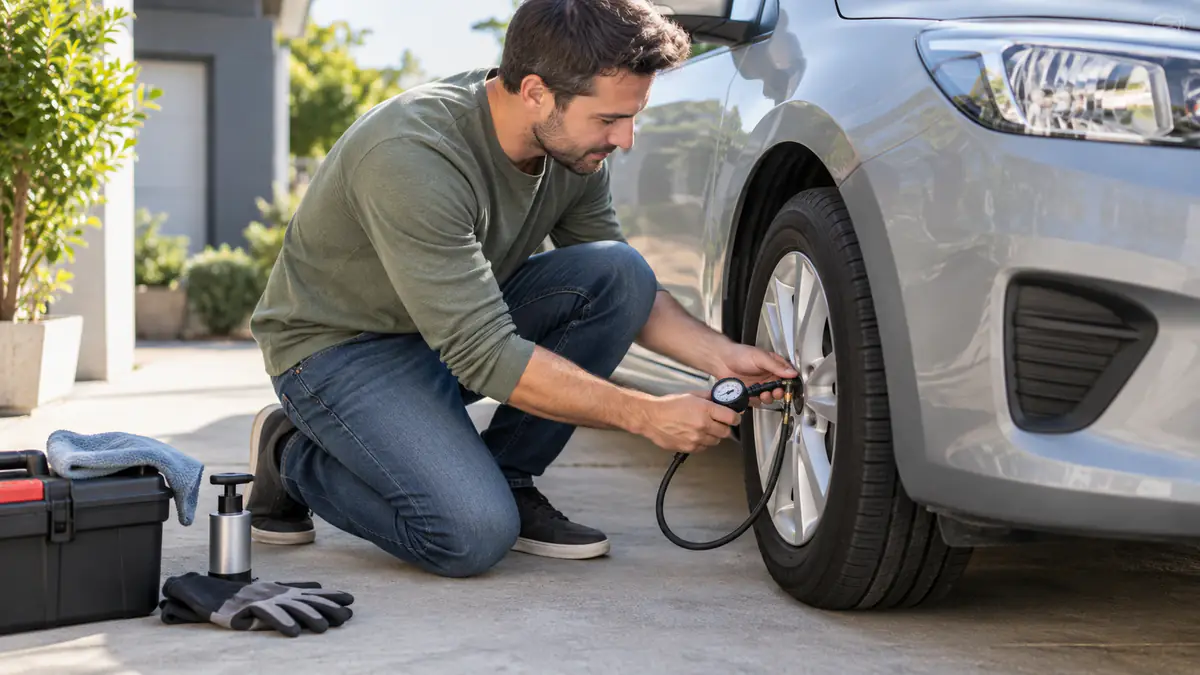
Under-inflated tyres raise rolling resistance, and they do it so gradually that you rarely notice. Check pressure when the tyres are cold, meaning before the car has been driven any real distance. A run to the forecourt warms the air and lifts the reading, which can hide a slow leak. Use the pressures listed on the door pillar or in the manual, not the maximum printed on the sidewall. Nitrogen fills and seasonal swings matter far less than simply staying near the recommended figure, and low pressure also wears the shoulders, so the cost is not only fuel.
Weight and aerodynamic drag
Extra weight has to be accelerated, so a boot full of tools, a roof rack left on all year, or a bike carrier you never remove all cost something. The penalty is largest in stop-start driving, where you accelerate that mass again every few hundred metres. Drag is more about speed: a roof box that costs little around town becomes noticeable on a motorway. Remove what you do not need for the trip, and take seasonal racks and boxes off between trips. Do not expect this to transform your bill. It is a small, steady saving that costs nothing to start.
Idling and cold starts
An idling engine burns fuel while covering no distance, which makes it pure waste. A modern engine warms up faster being driven gently than sitting on the drive, so there is little reason to idle to warm up. Switch off when you expect to wait more than roughly a minute, such as at a level crossing or while a passenger runs into a shop. A cold engine also runs rich for the first few minutes, so several short trips from cold use more per kilometre than one longer run. Both penalties vary a lot with engine design and climate.
Route and trip planning

The cheapest kilometre is the one you do not drive. Combining errands into a single loop, rather than making several separate cold-start trips, saves fuel with no change to how you drive. Navigation apps can route you around congestion, though the shortest distance and the lowest fuel use are not always the same road; steady traffic usually beats a shorter stop-start route. For a regular commute, compare your options over a full week rather than one morning. The daily commute calculator and the monthly petrol calculator both work from the distance and mileage you enter, so you can price two routes side by side.
Driving style
Smoothness matters more than slowness. Anticipate what traffic is doing and lift off early rather than braking late. Accelerate steadily instead of flooring it between lights, and hold a steady speed where the road allows. Higher speed raises drag sharply, so the single biggest change on a motorway is often just easing off the accelerator a little. This is not about crawling everywhere; it is about removing the wasted energy in hard acceleration and unnecessary braking. The gain depends on your current habits, so a driver who already drives smoothly has less to recover.
Air conditioning and windows
Air conditioning draws power from the engine and uses fuel whenever it runs. At low speed the penalty is proportionally larger, but it is usually small enough that comfort wins. At higher speed, open windows add drag, so running the air conditioning with the windows up is generally the better choice on a motorway. In town, an open window costs little. Either way the difference is modest next to how you drive, and it varies with the car, the outside temperature, and how hard the system has to work.
Fuel grade and additives
A higher-octane petrol is not automatically better. Use the grade your manufacturer specifies; a car designed for regular rarely gains measurable economy from premium, and some engines genuinely do ask for higher octane for a reason. Treat additive and fuel-saving device claims sceptically. When a product promises a fixed percentage improvement, the honest test is the same one you would apply to any change here: measure before, measure after, across several tanks. Such claims are hard to verify on a single vehicle and easy to believe. Buy the specified grade and leave the rest.
If you test one anyway
Run it like any other test here: record several full tanks before, add the product, then several after, keeping routes and driving steady. If the averages barely differ, the claim did not survive contact with your car.
Maintenance that affects consumption
A few service items genuinely change fuel use. A clogged air filter, worn spark plugs, a failing oxygen sensor, and dragging brakes can all raise consumption, while correct tyre pressures and fresh oil keep things near where they should be. When a warning light comes on, read it promptly, because a misfire or sensor fault often costs fuel before it costs performance. Tyre pressure and wheel alignment belong on the same list. Beyond these, most routine servicing protects the vehicle rather than your fuel bill. Do not assume every service will move the number.
Measuring whether a change helped

To test a change, hold everything else steady and compare like with like. Use full-tank measurements, the same routes, and similar weather, because cold and rain move consumption more than many of the tweaks above. Record litres and distance for several tanks before and after, then compare the averages, not single fill-ups. If a change saves two or three per cent, ordinary variation may swallow it completely, which is why a confident answer needs more data rather than more enthusiasm. The mileage calculator turns two fill-ups into a real km/L or MPG figure you can compare.
Limits and honest expectations
Almost every claim above comes with a depends. A tyre-pressure change that helps one driver does nothing for another who already checks weekly. Route savings vanish if every alternative is congested. Nothing here guarantees a fixed percentage, because the effect of any single change depends on your vehicle, your routes, the weather, and how you already drive. Be wary of any figure presented as universal. The realistic approach is to make the cheap, sensible changes, measure them, keep what works, and drop what does not.
Start with the baseline, then work through the list in that order. For how the calculators turn distance, mileage, and price into a figure, see the methodology page; for the maintenance and driving-style side in more detail, read improve fuel efficiency. Then run your own numbers, because the only estimate that matters is the one built from your own vehicle.
Published 18 September 2026. Reviewed 18 September 2026 by the Petrol Expense Calculator editorial team.