This is a records-first way to run a monthly petrol budget. You write down two numbers from the odometer and one from the pump at each fill-up, then do a little arithmetic once a month. No account, no subscription, no app watching where you drive. The whole system fits on one notebook page or one row per fill-up in a spreadsheet.
What to record at every fill-up
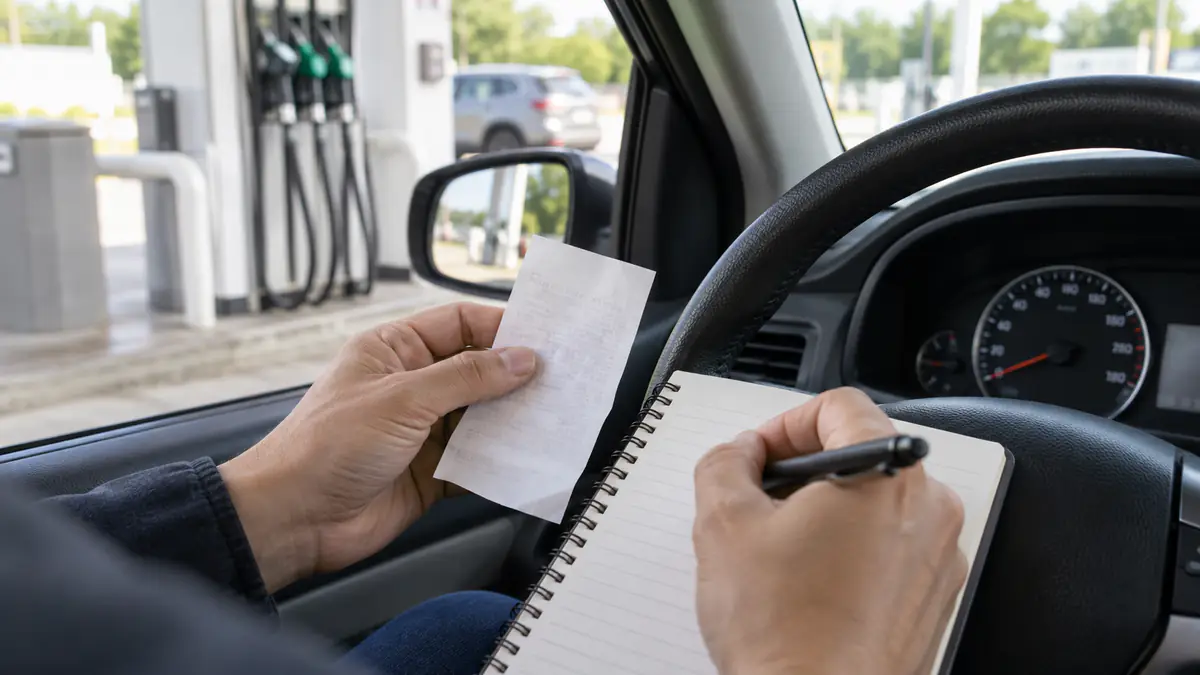
Five things, and they are all easy to muddle if you rush. The odometer total, the big number on the dash, not the trip meter that resets. The litres you added, read off the pump display or the receipt. The price per litre at that moment. The date. And whether the tank actually filled to the automatic shut-off, because a partial fill changes how you read the numbers later.
The odometer and the litres are measured values. The price is what the station charged you that day, which is why the exact figure beats a remembered average. Fill the row in at the pump, receipt in hand, before you drive off.
A five-column ledger
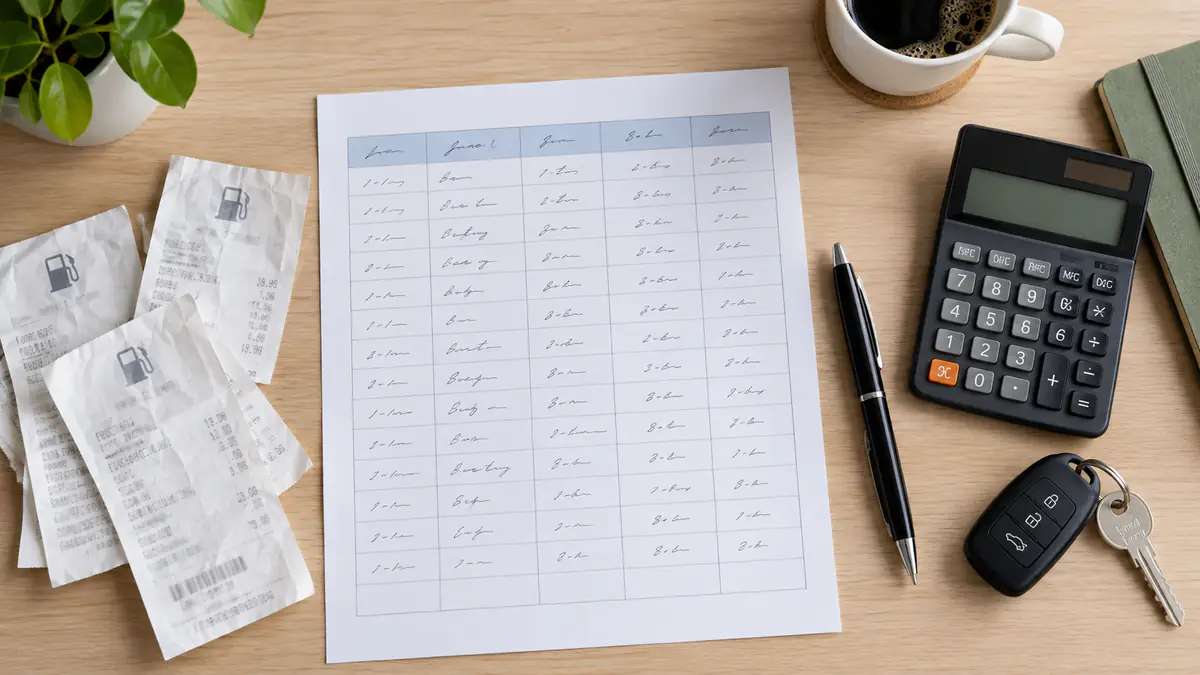
No software needed. A notebook page or a spreadsheet sheet with five columns is enough. Distance and km/L both come out of the other columns, so there is no reason to store them.
An illustrative ledger
| Date | Odometer (km) | Litres added | Full fill? | Price per litre |
|---|---|---|---|---|
| 3 Sep 2026 | 41,208 | 8.4 | Yes | P |
| 11 Sep 2026 | 41,590 | 9.1 | Yes | P |
| 19 Sep 2026 | 41,905 | 4.0 | No | P |
| 27 Sep 2026 | 42,244 | 12.2 | Yes | P |
Each row is one fill-up, kept in date order. The litres column is the one you total at month end, so every receipt has to land in it.
From fill-ups to real km/L
Real km/L comes from two consecutive full fills. Subtract the earlier odometer from the later one for the distance, then divide by the litres added at the second fill. Those litres are what you burned to cover that distance, because the tank started and ended full to the click.
Example: 41,590 minus 41,208 is 382 km. The second fill took 9.1 L. 382 ÷ 9.1 = 42.0 km/L. That figure describes one interval and nothing more; a highway run and a week of short trips give different answers, both correct for their conditions. Average four to six intervals before you lean on the number for planning.
If you record miles, either convert with 1.609344 km per mile or keep everything in miles and US MPG. One US gallon is 3.785411784 L, one Imperial gallon is 4.54609 L, and the two are not interchangeable. The methodology page sets out the conversions the calculators use.
Turning your data into a monthly budget
Two routes, answering slightly different questions. Sum the litres column and you have fuel used; multiply by the prices you paid and you have what you spent. That is the measured side. The planned side uses distance: monthly distance ÷ km/L gives litres, then litres × price gives cost.
It is the site formula — petrol cost = (distance ÷ mileage) × price — applied to a month instead of a trip. A 1,200 km month at 42 km/L needs about 28.6 L, so the cost is 28.6 × P, where P is your price per litre. If your driving is steady, the planned route is enough and the Monthly Petrol Calculator will run it for you. If your weeks vary, trust the receipts and keep the distance figure as a cross-check.
Forecasting next month
Next month's price is unknown, so forecast across a band instead of pretending to a single number. Take your monthly distance and your planning km/L, then run the sum at several prices. At 1,200 km and 42 km/L you need about 28.6 L: 51.4 at P = 1.80, 57.1 at P = 2.00, and 65.7 at P = 2.30. All illustrative.
Then push the mileage side. A heavy-traffic month at 38 km/L needs about 31.6 L, roughly three litres more than the 42 km/L case, which is usually a smaller move than the price swing across the same band. Over one month, price tends to shift your total more than a modest change in efficiency. Budget near the middle of the band and treat the top of it as your ceiling.
Handling partial fills and missed entries
A partial fill breaks the full-to-full rule, because you cannot tell how much of the tank you replaced. So only compare full fills. Total every litre added between two full fills, partials included, and divide the distance between those two full-fill odometers by that total. Once the partials are folded into the interval, they stop being a problem.
A missed fill-up is harder. You do not know those litres and you cannot recover them by guessing, so drop that interval from your efficiency figures and restart at the next clean full-to-full pair. For spending, put a clearly labelled estimate in the gap so the month's total is not short, and keep it marked so it never gets confused with a measured figure.
Filling at the same pump and the same brand, and always to the click, keeps the readings comparable. It is a small habit that saves a lot of doubt later.
Reviewing the month in ten minutes

Pick a fixed day you will actually remember — the first, the last, whatever fits your routine. Add the litres column for total fuel, and either add the receipt totals or multiply through by the prices you recorded for total spend. Read the first and last odometer entries for the month to get distance, then divide for km/L.
Compare three things with last month: litres, spend, and km/L. Spend up with litres flat means price. Litres up with spend roughly flat means you drove more. More litres for the same distance means efficiency dropped, so check tyre pressure and the service book. Note anything unusual, a long trip or a partial you never reconciled, so the next comparison is honest.
Using records for business or tax
A dated ledger with litres, cost, and odometer readings is the sort of evidence that supports a fuel or mileage claim, and it is far easier to assemble than a shoebox of receipts in January. Keep the receipts as well; in most places the ledger supplements them rather than replacing them.
Whether fuel is deductible, whether you claim actual costs or a mileage rate, and how business and personal kilometres must be split depends on your jurisdiction and on how your accountant wants it filed. This page does not give tax advice. Check with them before you build a claim, and set the ledger up the way they ask from day one.
When your budget and reality diverge
Find the cause before you change the number. Price movement is the usual answer and the quickest to confirm from a column you have been keeping. Distance comes next: extra trips, a longer school run, a holiday. Efficiency third: traffic, load, air-conditioning, soft tyres, a service that is overdue. Then the dull one, a data error — a missed fill or a partial counted as full.
A one-off trip should not reset your baseline; a persistent shift should. Rebuild the budget from your last three measured months rather than your cheapest one, and keep the old figure so you can see which direction you moved.
No app required
None of this needs an account. A notebook and a pen work, and so does a spreadsheet that never leaves your machine. The calculators on this site run in your browser from numbers you type; they do not ask you to sign in and they do not keep a fill-up history. Odometer readings, location patterns, spending — it all stays where you put it.
If you would rather not keep a ledger at all, a one-off calculation for a trip or a month is still useful; you just will not have last month's figures to compare against. The Daily Commute Calculator and the monthly tool above cover the most common cases.
Published 18 September 2026. Reviewed 18 September 2026 by the Petrol Expense Calculator editorial team.